Hands-on guide
Hermes Agent and Finaxis: an Accounts Receivable Analyst With Sub-agents
Last updated: · 7 min
Lire en françaisHermes Agent, the open-source agent from Nous Research, can split a task between sub-agents and keep working until the job is done. Connected to Finaxis through its MCP server, it can do the analysis a fractional CFO would do before a meeting: rank the payers, prepare the files, check the data and recommend decisions.
This guide shows one way to use it with Finaxis: what it produces, how to run it on a schedule and what stays with a person.
Quick Answer: Hermes Agent with Finaxis
- What it does: ranks every customer A, B or C, prepares customer files through sub-agents, checks the data before any reminder and recommends decisions
- How: the Finaxis MCP server at https://api.finaxis.ai/mcp, with a service account whose token a secrets command renews at each start
- What it cannot do with read scopes: change anything in Finaxis
- What it found on its own: unapplied credits, missing payment links, payments imported late
The mandate: who are our good and bad payers?
We gave Hermes the question a CEO asks a fractional CFO, connected it to Finaxis with a read-only service account, and let it work. It read the eight customers of the demo portal, their payments over six months, their invoices and their collection history, then ranked them. Its verdict: no customer sufficiently proven A.
The A, B, C scale comes from our prompt, not from Finaxis. Hermes ranked each customer from its balance, delay, risk, payments and kept payment arrangements over six months:
- A, reliable: pays on time, and six months of payments prove it. No customer reached that level of proof.
- B, to watch: little or nothing overdue, but a signal to follow, such as a high average delay, an arrangement that cannot be reconciled or replies without a commitment.
- C, at risk: a balance overdue for more than 90 days.
- Provisional: a class to confirm, because the customer's email is unusable and its data must be checked before any reminder.
| Customer (fictitious) | Class | Overdue (CAD) | Why, according to the agent |
|---|---|---|---|
| Aménagement Paysager Vert | B | 0.00 | Pays now, but an average historical delay of 72.5 days |
| Boulangerie Saint-Laurent | B | 0.00 | No payment recorded; an arrangement that cannot be reconciled |
| Quincaillerie Lavallière inc. | B | 300.00 | Replies without a verifiable commitment |
| Aida | C | 43,115.63 | Over 90 days; a payment arrangement for November 14 not yet due |
| Bleu Boreal | C | 14,601.83 | Due since January 20; no payment in six months |
| Usinage Prévert | C (provisional) | 1,200.00 | Over 90 days, no payment; unusable email |
| Traiteur Rivelune | C (provisional) | 850.50 | Over 90 days, no payment; unusable email |
| Imprimerie Onésime | C (provisional) | 430.25 | Over 90 days, no payment; unusable email |
Customer files prepared by sub-agents
Hermes can split a task between sub-agents. Asked to prepare the three largest overdue balances, it handed one customer file to each sub-agent in parallel, then put together a two-week plan. Each file holds an account summary, the open invoices, the collection history, the next recommended action and a reminder email, as a draft.
Its session allowed two sub-agents at a time: it prepared the third file itself and said so.
The checks it made before any reminder
- Credits of $114.98 not applied for one customer: reconcile them before claiming the balance.
- Invoices without a PDF or a payment link: do not promise a payment link that does not exist.
- Payments imported long after their real date, one paid on September 4 and imported on October 22: check the sync before calling a payment arrangement broken.
- A customer reply quoting a reminder with an inappropriate tone: review the templates before the next send.
Do not invent previous reminders or a broken promise. The absence of history does not prove the absence of exchanges outside the portal.
Three decisions for the CEO
- Put finance in direct contact with the two largest overdue customers this week, and submit any new credit to the CFO.
- Hold the reminders of the three accounts with an unusable email until their contact details are fixed.
- Get a dated commitment from the customer that replies without one, and track payment arrangements against receipts.
Run it as a scheduled job
An analysis that runs alone belongs on a service account, not on a person's access. Its token lasts one hour; Hermes fetches a fresh one each time it starts through a secrets command. The full steps are in Connect Hermes Agent to Finaxis.
# ~/.hermes/config.yaml
mcp_servers:
  finaxis_sa:
    url: https://api.finaxis.ai/mcp
    headers:
      Authorization: "Bearer ${FINAXIS_TOKEN}"

secrets:
  command:
    enabled: true
    command: "/home/you/.hermes/finaxis-token.sh"   # prints FINAXIS_TOKEN=<fresh token>
    helper_timeout_seconds: 10
override_existing: truehermes chat -q "You are the fractional CFO. With the finaxis_sa MCP server (read only), rank every customer A (reliable), B (to watch) or C (at risk) from its balance, delay, risk, payments and kept payment arrangements over six months, check the data before any reminder, and recommend 3 decisions to the CEO this week."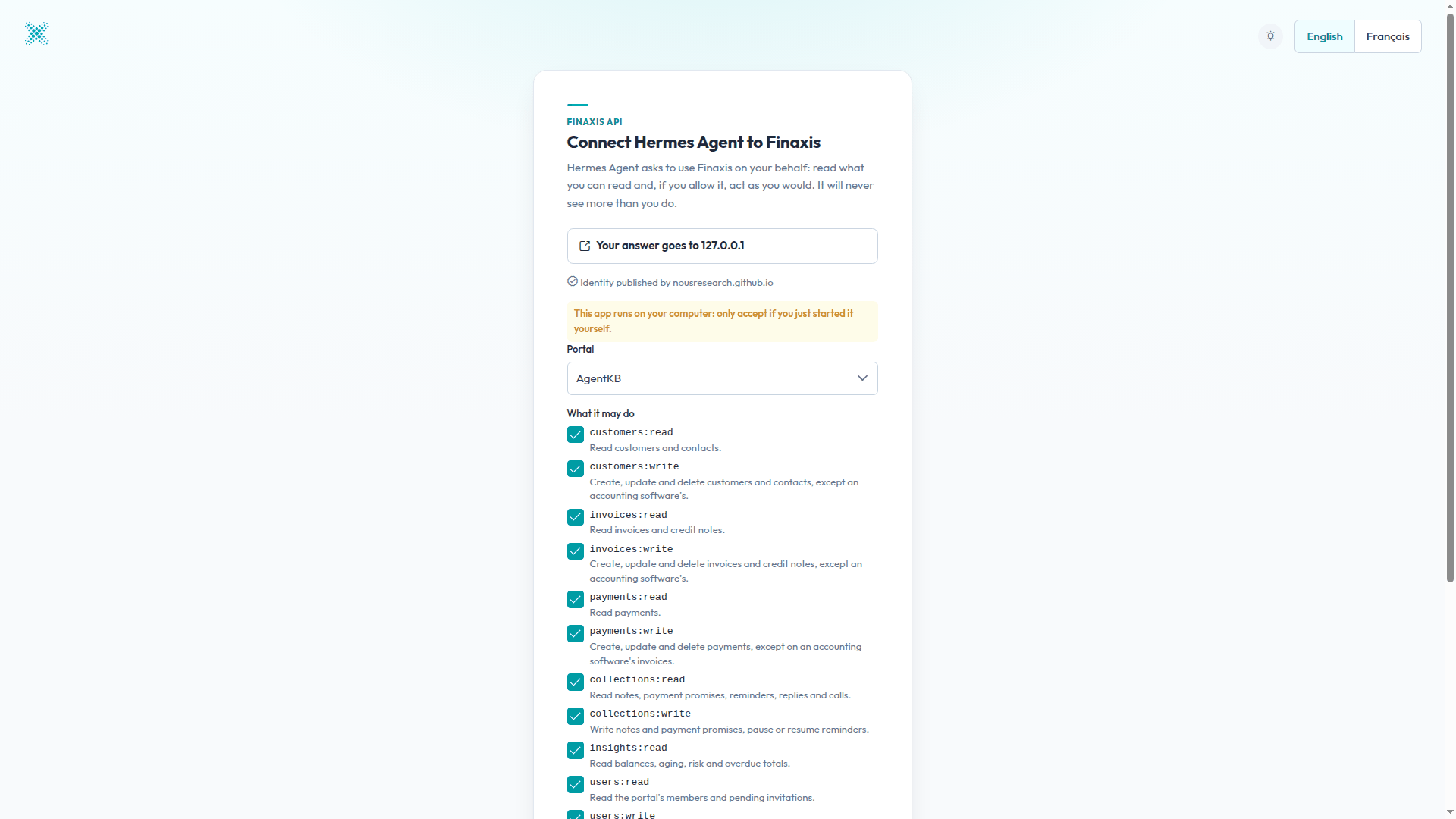
What stays with a person
- Sending: in this example, every email remained a draft for a person to review.
- Writing: with read scopes only, Hermes cannot change a customer, an invoice or a note.
- Decisions: credit terms, escalation and payment plans are recommendations for the CFO and the CEO.
- Access: each call is named in the request log, and the access is revoked in a click. See Choose how an AI agent connects to Finaxis.
This test ran on November 10, 2026, on a Finaxis demo portal connected to a QuickBooks demo company with fictitious customers, with Hermes Agent 0.23 and read-only access. The customers and amounts above are fictitious.
Frequently Asked Questions
Why a service account rather than my own access?
A job that runs alone should not depend on a person: a service account keeps working when a member leaves, carries its own name in the request log and has only the scopes the job needs.
How does Hermes get a fresh token every time?
A secrets command in its configuration runs each time Hermes starts and prints a new one-hour token. Each scheduled run starts a new session, so it always has a valid token.
What happens if the token is missing?
Hermes skips that server and goes on without failing. Run hermes mcp test before you schedule a job to make sure it finds the Finaxis tools.